In This Article
- Not All Tile Work Is Created Equal
- Materials: What Goes Behind the Tile Matters Most
- Substrate Preparation: Where 90% of Failures Begin
- Waterproofing: The Invisible Layer That Saves Everything
- Layout and Design Planning
- Cutting Precision: The Details You Can See
- Grout and Finishing
- The Craftsmanship Factor
- Why Cheaper Installs Fail
- When to Invest in Custom
- Key Takeaway
Not All Tile Work Is Created Equal
Walk into two different bathrooms. Both have tile on the walls, tile on the floor, a tiled shower. From ten feet away, they might look similar. But get up close — run your hand along the grout lines, check the corners where the walls meet, look at how the tile meets the ceiling — and the differences become obvious.
One was built to last. The other was built to look done.
That's the fundamental difference between custom tile installation and builder-grade tile work. It's not about the tile on the surface — it's about every decision made before that tile was ever set. The substrate prep. The waterproofing. The thinset. The layout. The cuts. These are the things that separate a shower that lasts 30 years from one that starts showing problems in five.
After 22 years of installing tile across Whitefish and the Flathead Valley, I've torn out enough failed work to know exactly where corners get cut — and what happens when they do. This article isn't about bashing anyone. It's about helping you understand what you're actually paying for when you invest in quality tile installation, so you can make the right call for your home.
Custom vs. Builder-Grade: At a Glance
| Factor | Builder-Grade | Custom Installation |
|---|---|---|
| Materials | Unmodified thinset, basic backer board | Modified/latex-modified thinset, premium backer or mud bed |
| Substrate Prep | Minimal — screw and go | Leveled, moisture-tested, crack isolation applied |
| Waterproofing | None or single coat of paint-on membrane | Full liquid membrane system, redundant layers at transitions |
| Layout Planning | Start in the corner, cut what's left | Full dry layout, centered patterns, sliver elimination |
| Cutting Precision | Snap cuts, visible chip-out | Wet saw, mitered edges, polished cuts on natural stone |
| Grout Quality | Pre-mixed cement grout | Epoxy or high-performance sanded grout, proper caulk joints |
| Timeline | 2–3 days for a shower | 5–10 days, proper cure times observed |
| Expected Lifespan | 5–10 years before issues | 25–40+ years |
| Cost | Lower upfront | Higher upfront, dramatically lower lifetime cost |
Materials: What Goes Behind the Tile Matters Most
The tile you pick out at the showroom is maybe 20% of the finished product. The other 80% is what goes behind it — and that's where custom tile installation and builder-grade work diverge immediately.
Thinset mortar is the adhesive that bonds tile to the substrate. Builder-grade work typically uses unmodified thinset — it's cheaper, easier to mix, and sets fast. Custom work uses modified or latex-modified thinset, which creates a significantly stronger bond with better flexibility. That flexibility matters in Montana, where temperature swings can stress rigid materials.
Backer board is another decision point. Standard installs use basic cement board screwed to studs. That works for some applications. But for custom showers, the gold standard is a hand-floated mortar bed — what we call a mud-set shower. It creates a perfectly pitched, monolithic substrate that drains properly and bonds tile like nothing else can.
"The materials behind the tile determine how long that tile stays on the wall. You'll never see them once the job is done — but you'll absolutely feel the difference when they're wrong."
Membrane systems follow the same pattern. Custom work uses manufacturer-specified waterproofing membranes applied as complete systems — not just a coat of paint-on sealer at the shower floor and calling it done.
Substrate Preparation: Where 90% of Failures Begin
If there's one thing I wish every homeowner understood about tile, it's this: ninety percent of tile failures start behind the tile. Not with the tile itself. Not with the grout. With the surface it was set on.
Proper substrate preparation includes:
- Leveling — Floors that aren't flat create lippage (uneven tile edges). A custom installer will self-level floors or float walls to create a true plane before any tile is set.
- Moisture testing — Concrete slabs hold moisture. Tile set over a wet slab will debond. We test moisture levels before committing to an installation method.
- Crack isolation — Concrete cracks. Houses settle. An uncoupling membrane or crack isolation layer prevents those movements from telegraphing up through the tile.
- Structural integrity — Is the subfloor stiff enough? Tile needs a deflection rating of L/360 or better. If the floor bounces when you walk across it, the tile and grout will crack. Period.
Builder-grade work often skips all of this. The backer board goes up, the tile goes on, and the crew moves to the next job. It looks fine on day one. The problems show up in year two or three.
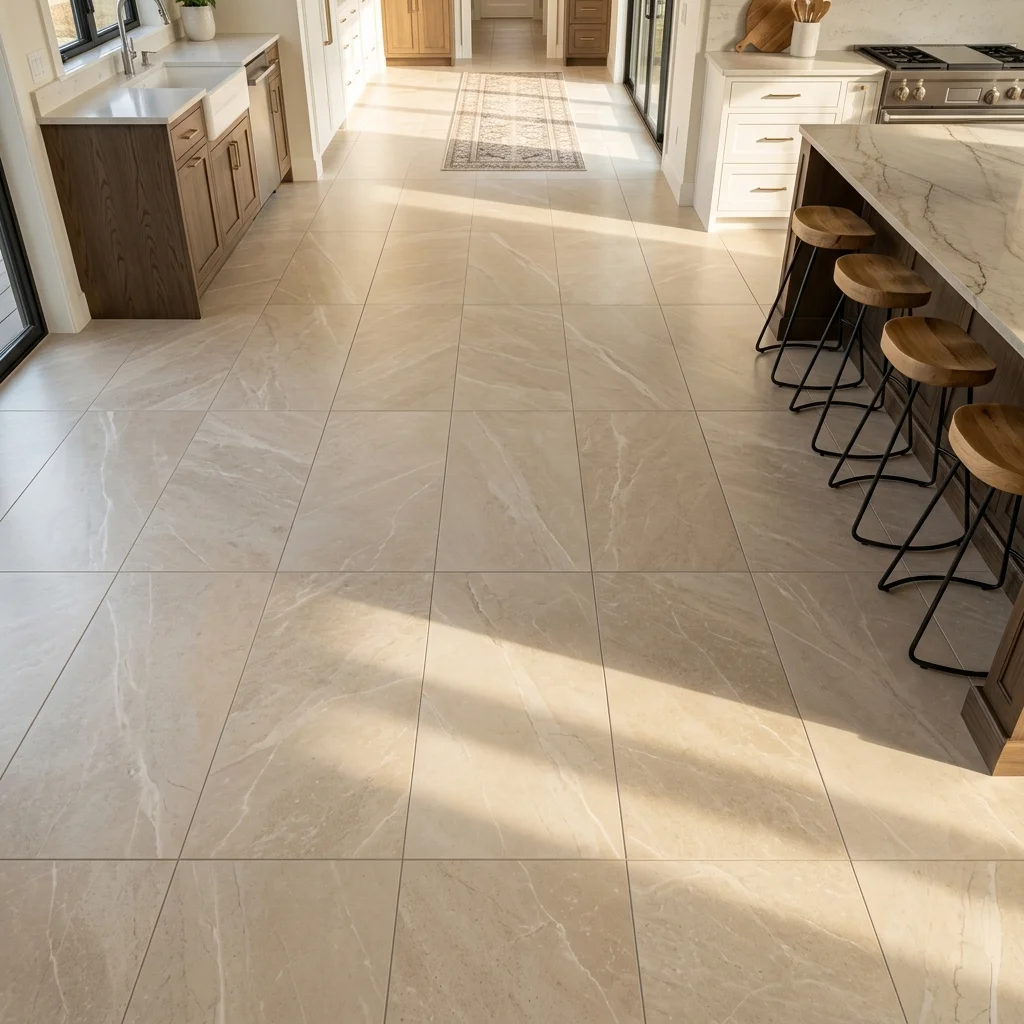
Proper substrate preparation ensures tile bonds correctly and lasts for decades.
Waterproofing: The Invisible Layer That Saves Everything
Water is the number one enemy of any tile installation — especially in a shower. And waterproofing is where the gap between custom and builder-grade becomes most consequential.
A professional tile installation in a wet area means:
- Full liquid-applied membrane on all shower walls and the floor — not just the lower half
- Reinforced transitions at corners, curbs, niches, and where walls meet the floor
- Flood-tested pre-slopes before the finish tile ever goes on
- Proper drain integration with bonding flanges seated into the waterproofing system
Builder-grade installs often use no dedicated waterproofing at all — relying on the cement board itself (which is not waterproof) or a single thin coat of liquid membrane without fabric reinforcement at the transitions. Those transitions are where water finds a path. Every time.
Why Waterproofing Is Non-Negotiable
A shower produces gallons of water daily. Without a complete waterproofing system, moisture migrates through grout, past the tile, and into the wall cavity. By the time you see staining or mold on the other side of the wall, the framing damage is already significant. Proper waterproofing costs a few hundred dollars. Fixing water damage costs thousands.
Layout and Design Planning
This is where craftsmanship becomes visible. Layout planning is the difference between tile work that looks intentional and tile work that looks like someone just started in a corner and hoped for the best.
A custom tile installer will:
- Dry-lay the entire pattern before setting a single tile — checking symmetry, centering focal walls, and adjusting for sightlines
- Eliminate slivers — those thin, awkward cuts at edges that scream "afterthought." Adjusting the starting point by half an inch can eliminate them entirely.
- Match patterns — especially with natural stone or large-format porcelain that has veining or directional grain
- Plan niche placement — centering shower niches within the tile grid so they don't interrupt grout lines awkwardly
- Account for gravity — large tiles on walls need specific setting sequences to prevent slippage during cure
None of this is visible in a line-item bid. But it's immediately visible on the finished wall. Layout is the thing homeowners notice intuitively, even if they can't articulate exactly what's different.
Cutting Precision: The Details You Can See
Tile cutting is a skill that separates experienced installers from everyone else. It's also where luxury tile installation becomes most visually apparent.
Wet saw technique matters. A proper wet saw with a quality diamond blade produces clean, chip-free cuts. Builder-grade crews often use snap cutters for speed — they're faster, but they leave rougher edges and can't handle curves, notches, or L-cuts.
For natural stone, cutting is even more critical. Marble and travertine chip easily. Porcelain requires specific blade types. And mitered edges — where two tiles meet at an outside corner with a 45-degree cut — are the hallmark of high-end work. Builder-grade installs almost always use plastic edge trim instead. It's functional, but it doesn't compare.
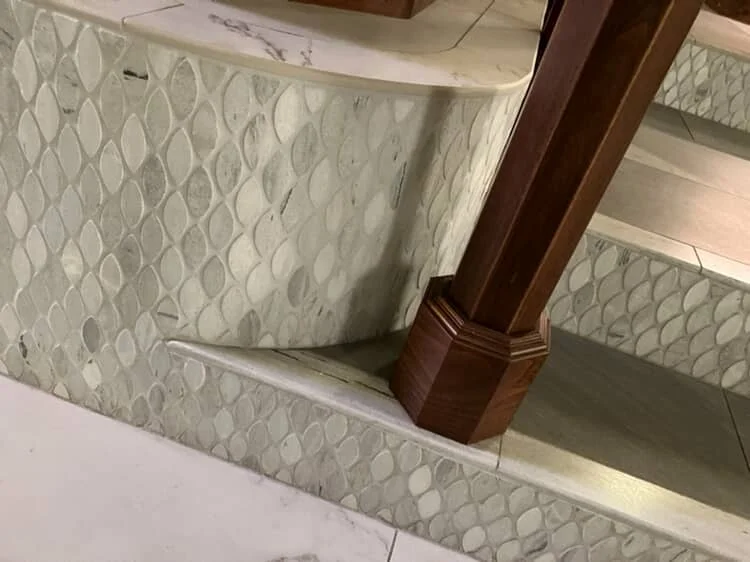
Clean cuts and mitered edges are hallmarks of custom tile craftsmanship.
"Anybody can set tile in the middle of a wall. It's the edges, the corners, the transitions — that's where you see the difference between someone who does this for a living and someone who's just getting it done."
Grout and Finishing
Grout is the final step most people focus on, but there's more to it than color choice.
Epoxy grout vs. cement grout: Standard cement grout is porous — it absorbs water and stains. Epoxy grout is nearly impervious to moisture and staining, making it ideal for showers, kitchen backsplashes, and floors that see heavy use. It costs more and is harder to work with, which is exactly why builder-grade crews avoid it.
Caulk joints are often overlooked entirely. Everywhere tile meets a different material — the tub, the shower pan, a window sill — should be caulked, not grouted. Grout is rigid. Buildings move. A grouted change-of-plane joint will crack within the first year. Every time. A proper installation uses color-matched silicone caulk at every transition.
Cleanup and haze removal are the finishing details. Builder-grade work often leaves grout haze on the tile surface — that cloudy film you see in certain light. Custom work includes thorough haze removal and a final inspection pass before the job is called complete.
The Craftsmanship Factor
There's something beyond technique that distinguishes truly custom work. It's harder to quantify, but you see it in the results.
When I build a mud-set shower, I'm hand-floating a mortar bed to create the pitch. Not following a pre-made foam pan's geometry — building the geometry from scratch to match the exact dimensions of the shower. That bed is screeded, checked with levels, and adjusted until the pitch is right. It takes hours, not minutes. And it produces a shower floor that drains properly from every point, with no low spots where water sits.
That same attention shows up in how tiles are back-buttered for full coverage, how spacers are set for consistent grout lines, how each tile is checked for level and plane as it's set. It's the difference between treating each tile as an individual decision and treating the whole wall as one surface that needs to be perfect.
"Custom work isn't about spending more money. It's about spending more time — on the steps that matter. The tile on the surface is the last thing we install. Everything underneath it is what we build our reputation on."
Why Cheaper Installs Fail
I don't say this to scare anyone — I say it because I've made a career of fixing these problems. Here's what I see when I tear out failed tile work:
The 5–7 year shower: This is the most common failure I encounter in bathroom remodeling tear-outs. A shower installed with minimal waterproofing that starts showing mold, soft spots, or water staining on adjacent walls within five to seven years. By that point, the damage behind the tile is often more expensive to repair than the original installation cost.
Lippage: Uneven tile edges caused by an unlevel substrate or inconsistent thinset application. Beyond being a visual problem, lippage is a trip hazard on floors and a water-trapping issue on walls.
Hollow tiles: Tiles that sound hollow when you knock on them weren't fully bonded to the substrate. They'll eventually crack under foot traffic or simply pop off the wall. This happens when thinset coverage is below 80% — which it frequently is in speed-focused installs.
Grout cracking: Almost always caused by movement — either the substrate wasn't properly isolated from structural movement, or grouted joints were used where caulk joints should have been. Rigid grout in a joint that flexes will crack every single time.
The Real Cost of Cheap Tile Work
A budget tile shower might save $2,000–$4,000 upfront compared to a custom installation. But when that shower fails in 5–7 years, the tear-out, water damage repair, and reinstallation can easily cost $8,000–$15,000. The most expensive tile installation is the one you have to do twice.
When to Invest in Custom
Not every tile project needs the full custom treatment. A utility room floor or a rental property bathroom may not justify the investment. But there are situations where custom installation isn't just worth it — it's the only approach that makes sense:
- Custom homes — If you're building a custom home in Whitefish or the Flathead Valley, the tile work should match the quality of everything else. Builder-grade tile in a custom home is a mismatch that shows.
- Primary bathrooms — Bathrooms you use every day, twice a day, for decades. This is where waterproofing, substrate prep, and material quality pay for themselves many times over.
- Natural stone — Marble, travertine, and slate require specialized handling, sealing, and cutting techniques. Natural stone installation done at a builder-grade pace results in cracked tiles and stained surfaces.
- Showers — Any shower. Water exposure makes every shortcut more consequential. A properly built shower is one of the best investments you can make in a home.
- Kitchen backsplashes in focal areas — A backsplash you see every day while cooking should have clean cuts, thoughtful layout, and proper finishing.
- Resale value — Quality tile work is one of the few home improvements that buyers can immediately see and appreciate. It signals that the home was built or maintained with care.
Key Takeaway
What You're Actually Paying For
The difference between custom tile installation and builder-grade work isn't the tile — it's everything underneath it. Modified thinset. Level substrates. Complete waterproofing. Thoughtful layout. Precise cuts. Proper grout and caulk joints. These are the decisions that determine whether your tile lasts 5 years or 40.
When you hire a custom tile installer, you're not paying for fancier tile. You're paying for the experience and discipline to do every invisible step correctly — because those invisible steps are what keep the visible surface looking perfect for decades.
If you're planning a tile project and want to understand what the right approach looks like for your specific situation, I'm happy to walk through it with you. No pressure, no sales pitch — just honest advice from someone who's been doing this for over two decades.