In This Article
Why This Comparison Matters
If you're planning a bathroom remodel in the Flathead Valley, you'll run into this question fast: should your shower be built with a traditional mortar bed or a modern foam panel system like Schluter Kerdi Board?
It's not a trivial decision. The method behind your tile determines how long that shower will last, how it handles water, and whether the finished product feels like furniture or a prefab kit. I've built showers both ways for over two decades, and I've also torn out both types when they've failed. The differences are real — but they're not always what the marketing materials tell you.
This article breaks down the honest comparison. No brand loyalty, no ideology. Just what I've learned setting tile in Whitefish and across northwest Montana since 2004.
How Each System Works
The Mud-Set Process
A mud-set shower starts with a hand-packed mortar bed — a carefully sloped deck mud mix applied over a waterproof membrane (usually a hot-mopped or sheet membrane liner). The mortar is screeded to precise pitch, typically a quarter-inch per foot toward the drain. The walls receive a scratch coat of mortar over metal lath, creating a perfectly flat, rock-solid substrate.
Every surface is built by hand. The slope is checked with a level. The walls are plumbed and trued. When the mortar cures, you have a monolithic, load-bearing substrate that's bonded to the structure of the house. Tile goes directly onto this cured mortar bed using thinset.
The entire process takes 3–5 days of skilled labor before tile ever touches the wall. For a deeper explanation, see our guide on what a mud-set shower actually is.
The Foam Panel / Kerdi Board Process
Foam shower systems — Schluter Kerdi Board is the most recognized, but Wedi, GoBoard, and several others compete in this space — use pre-manufactured extruded polystyrene (XPS) panels as both the substrate and the waterproofing layer. The panels come in fixed thicknesses and sizes, are cut to fit, and are fastened to wall studs with screws and washers.
The shower floor uses a pre-formed foam pan (like the Schluter Kerdi Shower-ST) with the slope already molded in. Seams between panels are sealed with waterproof membrane strips and Kerdi-Band. Tile is set directly onto the foam surface with modified thinset.
A competent installer can have walls and a floor ready for tile in a single day. That speed is one of the system's genuine advantages.
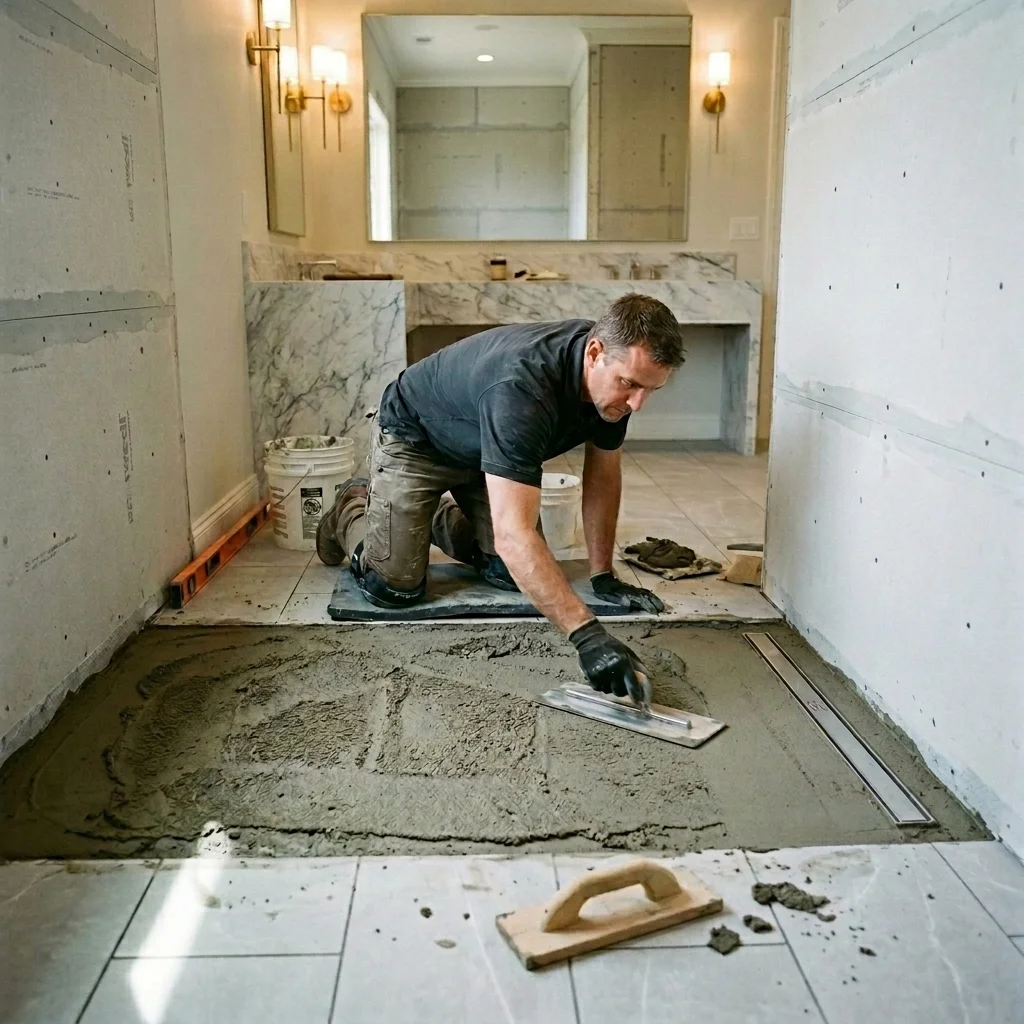
A traditional mortar bed shower pan hand-packed and sloped to drain — the foundation of a mud-set shower installation.
Head-to-Head Comparison
| Factor | Mud-Set Shower | Foam System (Kerdi / Wedi) |
|---|---|---|
| Durability | Extremely high — monolithic mortar bonded to structure | Good — foam core is stable but softer underfoot and less impact-resistant |
| Expected Lifespan | 30–50+ years with proper installation | 10–20 years; membrane and seam integrity degrades over time |
| Customization | Unlimited — any shape, size, slope, niche, or bench configuration | Limited to manufacturer's pan sizes and panel dimensions |
| Waterproofing | Multiple redundant layers (membrane + mortar + thinset) | Single membrane system — seam tape is the weak point |
| Installed Cost | $2,500–$5,000+ for substrate (before tile) | $800–$2,000 for substrate (before tile) |
| Skill Required | High — years of practice to build flat, plumb mortar beds | Moderate — manufacturer training, proper seam sealing |
| Installation Time | 3–5 days for substrate prep | 1 day for substrate prep |
| Repair Difficulty | Moderate — mortar is durable but localized repairs are straightforward | Difficult — compromised membrane requires panel replacement, often full tearout |
| Feel Underfoot | Solid, rigid — like standing on a stone floor | Slightly softer, can feel hollow if not fully bedded |
| Weight Capacity | Handles heavy stone, large-format tile, and thick bench builds | Weight limits apply — check manufacturer specs for heavy materials |
Durability and Lifespan
This is the single biggest difference, and it's not close.
A properly built mud-set shower is a mineral structure. The mortar cures into something closer to concrete than anything in a foam system. I've demoed 40-year-old mud-set showers where the mortar bed was still perfectly intact — the only reason they came out was because the homeowner wanted a new look. The substrate itself hadn't failed.
"I've torn out mud beds from the 1980s that were still solid as the day they were packed. The tile style changed — the mortar didn't care."
Foam systems don't have that track record yet. The products haven't been on the market long enough for us to know what a 30-year-old Kerdi Board shower looks like. What I do know — from tearouts I've done at the 8- and 12-year marks — is that seam tape can delaminate, foam can degrade at fastener points, and the waterproof membrane becomes the single point of failure. When it fails, water gets into the wall cavity. By the time you see the damage, it's behind the tile.
That's not a knock on the product engineering. It's a statement about materials: cured portland cement mortar is one of the most durable building materials humans have ever made. Extruded polystyrene is a good product, but it's plastic foam. They are not in the same longevity category.
Customization and Design Freedom
If you want a custom shower with unusual dimensions, a curbless zero-entry threshold, an integrated floating bench, or a floor that slopes to a linear drain set at an angle — mud-set is the only way to get there.
Mortar doesn't come in fixed sizes. It goes where you put it. I can build a curved shower floor, a trapezoidal pan, or a walk-in wet room with continuous slope from the bathroom floor through the shower — because I'm shaping the substrate by hand. The design possibilities are limited only by the tile layout and the laws of gravity.
"Foam systems give you the shapes the factory decided to manufacture. Mud-set gives you any shape you can draw on a napkin."
Foam pans are pre-sloped, which means you're locked into the manufacturer's drain location and pan dimensions. Schluter's largest Kerdi Shower-ST tray tops out at 72" × 72". Need a 38" × 84" shower with an off-center drain? You're back to mortar. Want a bench that's not a bolt-on afterthought? Mortar.
For production homes or standard-sized showers, the pre-formed options work fine. But for custom homes in the Flathead Valley — where owners are investing in one-of-a-kind bathrooms — the design constraints of foam systems become real limitations.
Waterproofing: Layers vs. Membranes
Both systems are waterproof when installed correctly. But they achieve it very differently, and those differences matter when something goes wrong.
A mud-set shower uses redundant waterproofing. The primary membrane sits behind the mortar bed — either a hot-mopped asphalt membrane or a sheet membrane like Oatey's PVC liner. The mortar itself is not waterproof, but it manages moisture. Water that penetrates the grout hits the mortar, weeps down through the bed, and is collected by the membrane at the pre-slope layer, directing it to weep holes in the drain assembly. The system is designed to handle water at multiple levels.
Foam systems use surface waterproofing. The Kerdi membrane, fleece-backed and bonded to the surface with thinset, is the single waterproof layer. If the membrane is intact and seam tape is properly embedded, zero water reaches the wall cavity. But if a seam tape joint wasn't fully embedded, or if a screw penetration wasn't properly sealed, water can get behind the membrane — and once it's there, there's nothing to catch it.
Neither system fails when it's installed perfectly. The question is what happens when installation isn't perfect — and over decades of thermal cycling, seasonal movement, and daily use, "perfect" is a high bar to maintain forever.
Cost Comparison
Let's be straightforward: mud-set showers cost more. Significantly more.
For the substrate alone (not including tile), a mud-set shower in the Flathead Valley typically runs $2,500–$5,000+ depending on size and complexity. That's 3–5 days of skilled labor plus materials — sand, portland cement, lath, membrane, and drain assembly.
A foam system substrate for the same shower might run $800–$2,000. The materials cost more per panel than a bag of sand and cement, but the labor is dramatically less. One day versus five.
Here's the cost calculation most people miss: amortized over the life of the shower, mud-set is often cheaper. If a mud-set shower lasts 40 years and a foam shower lasts 15, you're paying for the foam shower almost three times. The second and third installations include demolition, disposal, potential water damage repair, and a week without a functioning bathroom.
A $4,000 mud-set substrate over 40 years costs $100/year. A $1,500 foam substrate replaced every 15 years costs $100/year in materials alone — but you're also paying for two additional demolitions, two additional tile installations, and the disruption each time.
The upfront number is higher. The lifetime cost often isn't.
When Foam Makes Sense
I'm not here to tell you foam systems are bad. They're not. They solve real problems, and for certain projects, they're the right call:
- Rental properties and investment builds: When the goal is a functional, clean bathroom at a controlled budget, foam systems deliver reliable waterproofing at a fraction of the labor cost.
- Standard-sized showers: If your shower fits a manufacturer's pre-formed pan dimensions and you don't need custom features, foam gets you to tile day faster.
- Budget-conscious remodels: A properly installed Kerdi system is dramatically better than a poorly built mud bed. If your budget doesn't stretch to a skilled mud-set installer, a well-done foam system is the smarter choice.
- Second bathrooms and guest baths: Spaces that get lighter daily use don't need the 50-year lifespan of a mud-set build.
- Time-sensitive projects: If you need the bathroom back in service quickly, saving 3–4 days on substrate prep is meaningful.
The key with foam systems is meticulous seam sealing. Every joint, every screw penetration, every corner — that membrane has to be continuous. A good installer who follows the manufacturer's process precisely will deliver a shower that works well for its expected lifespan.
When Mud-Set Is the Right Choice
For the kind of work we do at Nautilus — custom showers, luxury primary bathrooms, homes where the owners plan to stay for decades — mud-set is what we recommend and what we build. Here's why:
- Custom homes and luxury builds: When you're investing $50,000+ in a primary bathroom, the substrate should outlast the mortgage. Mud-set delivers that.
- Non-standard dimensions: Any shower that doesn't fit a factory pan needs a hand-built substrate. That means mortar.
- Curbless and zero-entry showers: Curbless designs require precise slope control across the entire bathroom floor. Only a hand-floated mortar bed gives you that level of pitch accuracy.
- Heavy materials: Natural stone, large-format porcelain, and thick slab tiles need a rigid, load-bearing substrate. Mortar provides it. Foam has weight limits.
- Steam showers: The thermal cycling of a steam shower puts extreme stress on waterproofing seams. Redundant layers handle that stress better than a single membrane.
- Homeowners who plan to stay: If this is your forever home, you want a forever shower. Mud-set is the method that's proven to deliver that.
"If a homeowner tells me they're building their last home, I'm not putting foam behind their tile. I'm building them a shower that'll outlast both of us."
Montana-Specific Considerations
Building in the Flathead Valley adds factors that don't apply in Phoenix or Miami:
- Extreme temperature swings: Montana sees 130°+ degree annual temperature ranges (from -30°F to 100°F+). The structural movement this causes — expansion, contraction, settling — puts stress on waterproofing seams. Mud-set's monolithic structure absorbs this better than taped foam joints.
- Dry winters, radiant heat: Many Flathead Valley homes use in-floor radiant heat. Mortar beds are the ideal substrate for radiant systems in showers — they distribute heat evenly and handle thermal cycling without delaminating.
- Well water and hard water: Mineral-heavy well water is common here. Hard water deposits can work into grout and seams over time. A mortar bed system handles this mineral loading better because water management happens behind the tile, not at a surface membrane.
- Long-term ownership: Flathead Valley homeowners tend to stay in their homes. These aren't five-year flip projects. When someone builds a home in Whitefish or on Flathead Lake, they're investing in decades of use. The substrate should match that commitment.
- Skilled labor availability: Finding a true mud-set specialist in Montana is harder than in major metro areas. That scarcity actually makes the investment more valuable — a properly built mud-set shower here is rarer and more sought-after when resale comes.
The Bottom Line
Key Takeaway
Foam shower systems like Schluter Kerdi Board are well-engineered products that work reliably for standard showers, budget-conscious remodels, and properties where a 10–15 year lifespan is acceptable. They're faster to install and cost less upfront.
Mud-set showers are a different category of construction. They're hand-built, custom-fitted, and designed to last 30–50 years. For custom homes, luxury primary bathrooms, curbless designs, and homeowners who plan to stay — mud-set is the method that matches the investment.
The best shower system is the one that matches your goals, your budget, and your timeline. But if you're asking a craftsman what he'd put in his own home — it's mortar, every time.
If you're considering a bathroom remodel in Whitefish, Kalispell, or anywhere in the Flathead Valley and want to understand which approach is right for your project, we're happy to walk you through the options. No pressure, no pitch — just 22 years of perspective on what works and what lasts.
Planning a Custom Shower Build?
Get expert guidance on the right shower system for your Montana home — from substrate to finished tile.
Get a Free Consultation